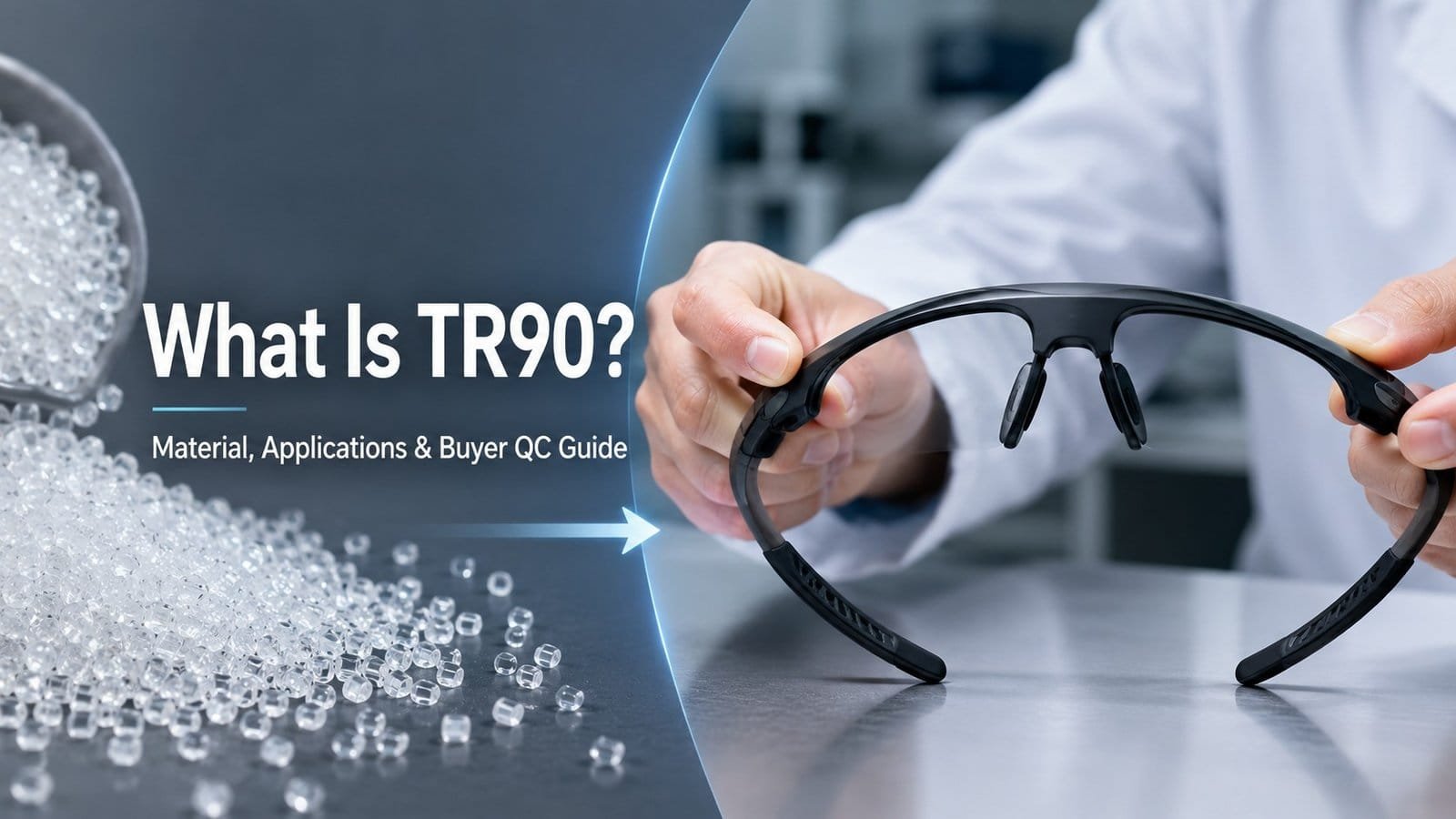
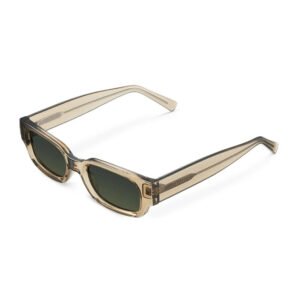
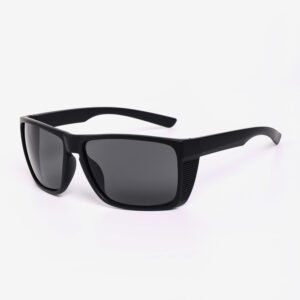
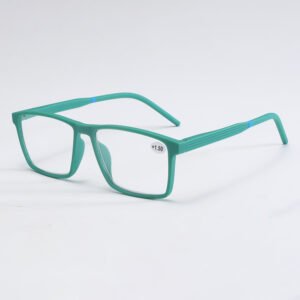
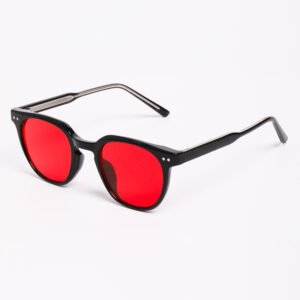
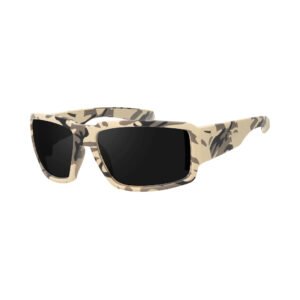
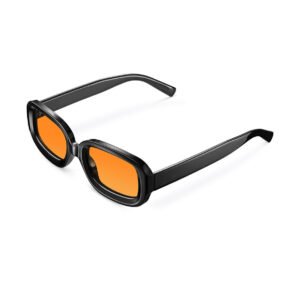
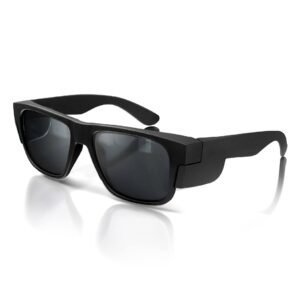
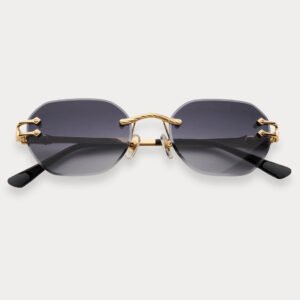
What is TR90? It is a lightweight, nylon-based thermoplastic commonly used for flexible optical frames, sports eyewear and safety glasses.
For wholesalers and eyewear brands, however, the material name alone is not enough. Two frames described as “TR90” can perform very differently because resin grade, frame thickness, hinge construction, injection settings and quality control all affect the finished product.
This guide explains where TR90 creates commercial value, where it has limitations and what buyers should inspect before approving a bulk order.
What Is TR90 Material?
TR90 generally refers to a transparent polyamide material developed for applications requiring low weight, strength and resistance to everyday chemicals.
One of the best-known materials in this category is Grilamid TR 90, produced by EMS-GRIVORY. The manufacturer describes its transparent polyamides as having low density, low moisture absorption, chemical resistance, flexural strength and thermal stability. Grilamid TR 90 is specifically positioned for optical frames and other precision visual components.
TR90 frames are normally produced by injection molding. Plastic granules are heated, injected into a metal mold, cooled and removed as a finished frame component.
This production method has an important commercial consequence: once the mold and injection process are stable, manufacturers can reproduce the same shape efficiently across larger quantities.
Is Every TR90 Frame Made from the Same Material?
No.
In eyewear sourcing, “TR90” is frequently used as a broad category name. Buyers should not automatically assume that every TR90 frame uses the same resin supplier, formulation or performance grade.
A responsible supplier should be able to explain:
- The resin brand or material specification
- Whether the material is virgin, recycled or blended
- Whether color masterbatch has been added
- Which components are TR90
- Whether the temples contain an internal metal wire
- Which tests were performed on the finished frame
The conclusion is simple: TR90 should be treated as a material specification to verify, not just a product-page label.
Why Is TR90 Used in Eyewear?
TR90 is used because it solves three common problems in performance eyewear: excessive weight, rigid frame pressure and breakage caused by minor deformation.
It Reduces Pressure During Long Wear
A heavy frame may look acceptable in a product photograph but become uncomfortable after several hours. Pressure around the bridge, ears and temples can lead to negative reviews, especially for sports, work and children’s eyewear.
TR90 has a relatively low density and allows manufacturers to create lightweight frame structures without making every section extremely thin. EMS-GRIVORY lists low density as one of the material family’s principal characteristics.
For B2B buyers, lower frame weight can mean:
- Better comfort during extended wear
- Fewer complaints about nose pressure
- A stronger selling point for active-use products
- Lower finished-product weight for shipping and packaging
It Supports Flexible Frame Designs
TR90 can tolerate controlled bending better than many rigid injection-molded plastics. This makes it suitable for wraparound structures, slim temples and products designed for frequent movement.
However, flexibility must be engineered into the entire frame. A flexible front does not prevent failure if the hinge screws loosen, the lens groove is too shallow or the temple connection is poorly reinforced.
The commercial conclusion is that buyers should evaluate the complete frame structure, not approve a product based only on a bending video.
It Works Well with Injection-Molded Production
Injection molding supports repeatable shapes, integrated structural details and efficient color production.
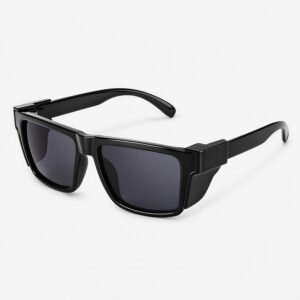
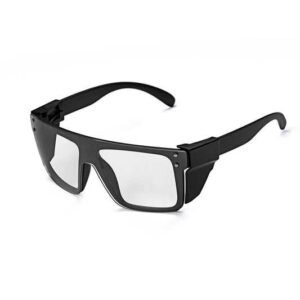
For example, a TR90 safety frame can combine the front rim, side coverage and structural connection points in one molded design. This can reduce the risk of detachable components being lost during industrial use. Our Z87 safety goggles use a TR90 frame with integrated side protection for this reason.
Advantages of TR90 Frames
1. Lightweight Comfort
The clearest advantage of TR90 is not simply that the frame feels light in the hand. Its real value is that it can make oversized, wraparound or full-coverage eyewear more comfortable.
This is especially important for products worn during:
- Cycling and running
- Construction and factory work
- Long driving periods
- School and screen use
- Outdoor activities
A lighter product is also easier for retailers to position as performance eyewear rather than ordinary fashion eyewear.
2. Useful Flexibility
Properly designed TR90 frames can flex under moderate pressure and recover their intended shape.
This can reduce damage caused by common retail situations, such as frames being compressed inside bags, roughly handled during product demonstrations or repeatedly removed with one hand.
Nevertheless, “flexible” should never be translated as “indestructible.” Extreme bending can still damage hinges, lenses, coatings or thin structural areas.
3. Resistance to Moisture and Common Chemicals
Eyewear is regularly exposed to sweat, skin oils, sunscreen, cleaning products and humid storage conditions.
EMS-GRIVORY highlights chemical resistance, stress-crack resistance and low moisture absorption as advantages of its transparent polyamides. These properties help explain why the material is used in demanding optical and lifestyle applications.
For a buyer, this may support more stable daily performance. It does not remove the need to test the actual frame color, logo ink, coating and assembly.
4. Consistent Shapes for Volume Production
After the mold and injection parameters are approved, TR90 can provide strong consistency across repeated production.
This is valuable for brands that need:
- Stable frame dimensions
- Repeatable lens fitting
- Consistent logo positions
- Multiple colors based on one mold
- Reorders of the same core design
The mold must still be designed correctly. Poor gate placement, uneven cooling or incorrect shrinkage control can create warped fronts, mismatched temples and unstable lens grooves.
5. Strong Fit for Performance-Led Collections
TR90 naturally supports a technical product story: lightweight, flexible and designed for active use.
That makes it easier to market in sports, workwear, children’s and outdoor collections where practical performance influences purchasing decisions.
Limitations of TR90 Frames
TR90 is useful, but it is not automatically the best material for every eyewear collection.
It Does Not Match Acetate’s Visual Depth
Premium acetate sheets can offer layered colors, tortoiseshell patterns, transparent effects and hand-polished surfaces. Mazzucchelli notes that cellulose acetate sheets can be produced in extensive solid, transparent, milky and multicolor combinations, making the material particularly suitable for high-end eyewear and fashion accessories.
TR90 can produce attractive solid, translucent and two-color effects, but it usually does not create the same handcrafted depth as polished acetate.
For a luxury optical collection, acetate may therefore support a higher perceived retail value.
Adjustment Can Be More Limited
Acetate frames can often be heated and adjusted by an optician. Metal temples can also be mechanically adjusted within their design limits.
TR90 structures may be more resistant to permanent reshaping. This is useful when shape recovery is the priority, but less convenient when a retailer expects extensive fitting adjustments.
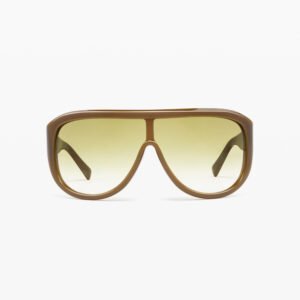
One practical solution is to combine a TR90 front with CP temples containing internal metal wires. The front remains lightweight, while the temple tips provide greater fitting flexibility. This construction is used in our oversize aviator sunglasses.
Thin Areas Can Still Fail
TR90 does not compensate for poor structural engineering.
Common risk points include:
- Thin bridges
- Sharp internal corners
- Weak hinge seats
- Insufficient material around screw holes
- Shallow lens grooves
- Excessive tension during lens assembly
A supplier repeatedly bending the thickest part of a sample does not prove that these smaller areas are reliable.
Color and Surface Quality Depend on Processing
Low-quality injection can leave flow marks, visible gate marks, uneven gloss or color differences between the front and temples.
For private-label projects, logo adhesion must also be checked. The correct printing, laser or transfer process depends on the material surface and logo design. Poorly cured ink can lose adhesion after exposure to sweat, sunscreen or cleaning chemicals.
TR90 Is Not a Safety Certification
A TR90 frame may be suitable for safety eyewear, but the material name does not prove that a finished product complies with ANSI Z87.1, AS/NZS 1337.1, CSA Z94.3 or another market standard.
Compliance depends on the complete product, including:
- Frame structure
- Lens material and thickness
- Lateral coverage
- Lens retention
- Markings
- Impact performance
Buyers sourcing protective eyewear should request a report that matches the actual model and product construction.
TR90 vs Acetate vs PC

| Buying Factor | TR90 | Acetate | PC |
|---|---|---|---|
| Production method | Injection molded | Cut and processed from sheets | Usually injection molded |
| Weight positioning | Lightweight | Usually more substantial | Lightweight to medium |
| Flexibility | High when correctly designed | Moderate and heat-adjustable | Usually more rigid than TR90 |
| Visual character | Technical, sporty, clean | Rich color depth and premium polish | Commercial, practical and cost-efficient |
| Best color effects | Solid, translucent and molded combinations | Tortoiseshell, layered, marble and custom sheet patterns | Solid, transparent and mass-market colors |
| Tooling requirement | Mold required for new structures | CNC tooling and development required | Mold required for new structures |
| Best commercial position | Performance and comfort | Premium fashion and optical | High-volume and price-sensitive collections |
| Main sourcing risk | Unverified resin or weak structural areas | Poor polishing, deformation or inconsistent sheet processing | Stress marks, rigid break points or cheap surface appearance |
Choose TR90 When Performance Comes First
TR90 is normally the stronger choice for sports, children’s, safety and lightweight optical eyewear.
The benefit is not only flexibility. It combines comfort, structural resilience and efficient repeat production.
Choose Acetate When Perceived Value Comes First
Acetate is better suited to boutique optical frames, premium sunglasses and designs where color depth, polishing and craftsmanship justify a higher retail price.
Our Mazzucchelli rectangular spectacle frames demonstrate this premium positioning.
Choose PC When Cost Control Comes First
Polycarbonate is widely used in eyewear frames and lenses because it supports durable, injection-molded products across large production volumes. Covestro identifies eyewear as an established application for optical-grade polycarbonate.
PC is often suitable for promotional sunglasses, fast-fashion products and entry-level collections. It can provide attractive pricing, but it normally offers less frame flexibility and a more commercial surface feel than a well-made TR90 product.
What Products Are Best for TR90?

Sports Sunglasses
Cycling, running, fishing and outdoor eyewear benefit from lightweight frames, wraparound shapes and pressure-resistant temples.
TR90 can support these requirements without creating the heavy feel associated with thick acetate structures.
Safety Glasses
Safety eyewear often needs full coverage without excessive weight. TR90 frames can be molded with side shields, wraparound fronts and reinforced connection areas.
Our photochromic safety glasses combine a TR90 frame with PC lenses for indoor and outdoor industrial use.
Children’s Eyewear
Children frequently twist, drop or compress their glasses. A lightweight, controlled-flex frame can reduce everyday damage and improve comfort.
Buyers should still inspect small parts, hinge security and lens retention. A flexible front does not make loose components acceptable.
Lightweight Optical Frames
TR90 works well for daily optical frames where comfort, simple colors and a modern technical appearance are more important than handcrafted surface depth.
It is particularly suitable for:
- Full-rim optical frames
- Blue-light glasses
- Reading glasses
- School eyewear
- Lightweight unisex collections
Oversized Frames
Large frames can quickly become uncomfortable when produced from heavy materials. A TR90 front helps control weight while preserving a larger fashion silhouette.
For better fitting flexibility, buyers can combine the TR90 front with wire-core CP temples.
Is TR90 the Right Material for Your Eyewear Project?
TR90 is a strong option when your customers value lightweight comfort, controlled flexibility and practical durability.
It is usually the right choice for sports eyewear, safety glasses, children’s frames and lightweight optical collections. Acetate remains stronger for premium color depth and handcrafted positioning, while PC is often more suitable for price-sensitive, high-volume programs.
The final decision should therefore follow the product’s retail position:
- Choose TR90 for performance and comfort.
- Choose acetate for premium appearance and craftsmanship.
- Choose PC for cost-efficient volume production.
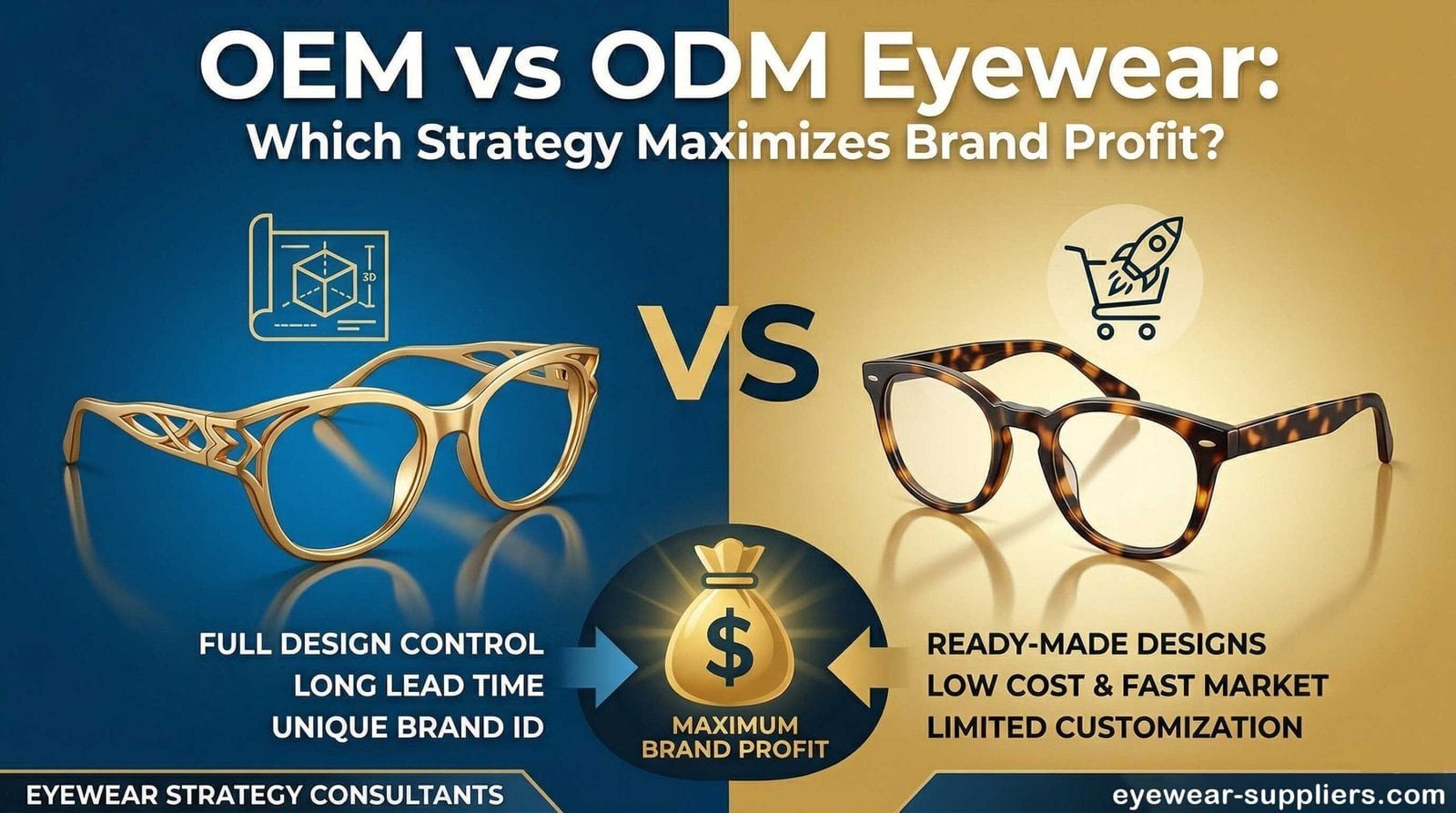
Yiwu Jinshi Trading Co., Ltd. supports wholesale, OEM, ODM and private-label eyewear projects using TR90, acetate, PC and metal materials. We can help evaluate your design, recommend a suitable material combination and prepare samples for structural, color and branding approval.
Send us your target market, expected quantity and product reference. We will provide three options: an existing mold, a light-customization solution and a fully developed OEM design.