Sourcing sunglasses from China becomes much easier when you stop searching for vague promises such as “cheap,” “high quality,” or “low MOQ” and start asking questions tied to your exact product.
A supplier cannot give you a meaningful price, MOQ, compliance answer or production schedule until the frame material, lens specification, customization level, quantity and target market are reasonably clear.
That is where many sourcing projects go wrong.
Buyers search for a “low MOQ sunglasses supplier” when what they really need to know is whether the MOQ applies to an existing frame with a logo, a custom color, or a completely new mold.
The better your questions, the more useful the supplier’s answers become.
Before Sourcing Sunglasses from China, Define What You Are Actually Buying
Two sunglasses that look nearly identical in a catalog can be completely different sourcing projects.
One may use an existing PC frame, standard tinted PC lenses and a printed logo. Another may use a custom acetate color, TAC polarized lenses, metal decorations, custom hinges and branded packaging.
They should not have the same price, MOQ or development time.
Before contacting a sunglasses supplier in China, define at least these purchasing variables:
| Purchasing Variable | Example |
|---|---|
| Product type | Fashion sunglasses, polarized sunglasses, sports sunglasses, kids’ sunglasses |
| Frame material | PC, TR90, acetate, stainless steel, alloy |
| Lens | PC, TAC polarized, nylon, CR39 |
| Lens function | UV protection, polarization, mirror coating, gradient tint |
| Customization | Logo only, custom color, hardware change, size modification, new mold |
| Quantity | Sample, 300 pcs, 1,000 pcs, 5,000 pcs |
| Target market | EU, USA, UK, Australia, South America |
| Packaging | OPP bag, pouch, case, branded retail box |
| Target launch date | Determines whether development time is commercially realistic |
The point: sourcing should begin with a product specification, not with a price request.
Once the supplier knows what you are buying, you can compare quotations on the same basis instead of comparing products that only look similar in photos.
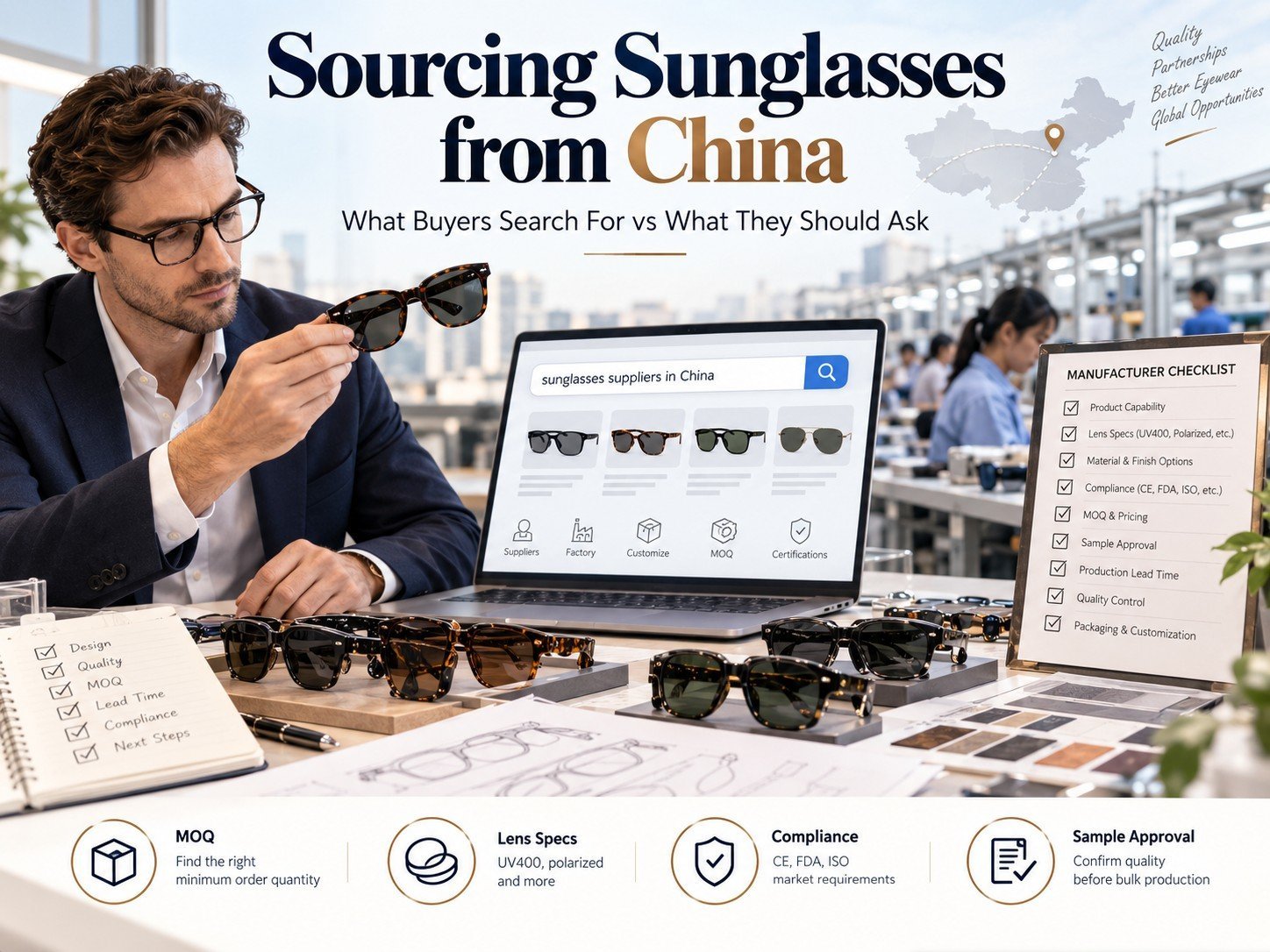
What Sunglasses Buyers Search For vs What They Should Actually Ask
| Buyers Usually Search | Better Question to Ask the Supplier |
|---|---|
| Low MOQ sunglasses | What is the MOQ for this specific level of customization? |
| Cheap sunglasses from China | What exactly is included in this quotation? |
| Custom sunglasses | Which components can actually be customized? |
| Polarized / UV400 sunglasses supplier | What are the actual lens specifications and test requirements? |
| CE / FDA sunglasses supplier | Which requirements apply to this product in my destination market? |
| Sunglasses samples | What exactly should I approve before mass production? |
| High-quality sunglasses factory | How do you control bulk-production quality? |
| Fast sunglasses supplier | What is the complete production timeline? |
| Reliable sunglasses supplier | What evidence can you provide before I place the order? |
The difference looks small, but commercially it is significant.
The first column produces marketing claims.
The second produces information you can use to make a purchasing decision.

Search: “Low MOQ Sunglasses” → Ask: “What Is the MOQ for This Level of Customization?”
“Low MOQ” is meaningless without defining what you want changed.
A supplier may offer a very low quantity for an existing stock frame with a simple laser logo because almost no product development is required.
Ask for a custom frame color, specially produced polarized lens, new metal decoration or newly developed mold, and the MOQ can change substantially.
A better conversation separates customization into levels.
Private label: Existing frame + existing color + your logo.
Light ODM: Existing structure + custom frame color, lens color, logo or packaging.
Modified design: Existing model with changed dimensions, temples, hardware or structural details.
Full OEM: New design, tooling, components and engineering development.
Each creates different production constraints.
For example, a factory may physically be able to assemble 100 custom sunglasses, but a material supplier may require enough raw material for 500 or 1,000 units.
That is why the right question is not:
“Can you do 100 pieces?”
Ask:
“Can you make 100 pieces with this frame color, polarized lens and logo, and which parts would require a higher MOQ?”
You will find the real production bottleneck much faster.

Search: “Cheap Sunglasses from China” → Ask: “What Is Included in the Price?”
A low unit price can become an expensive order when the quotation does not cover the same specification.
Consider two quotations:
Supplier A: $2.20
Supplier B: $2.65
Supplier A looks cheaper until you discover that polarization, logo printing, custom packaging and testing are additional charges.
Supplier B may already include them.
Before comparing prices, ask for a quotation breakdown covering:
Frame + lens + logo + accessories + packaging + testing + tooling + trade term.
Also confirm whether the price is EXW, FOB, CIF or DDP.
The purpose is not to force every factory to disclose its manufacturing cost. It is to make sure you are comparing the same finished product.
For B2B buyers, the relevant figure is rarely the lowest factory unit price.
It is the landed cost of a specification you can actually sell.

Search: “Custom Sunglasses” → Ask: “What Can Actually Be Customized?”
“Custom sunglasses” can describe anything from printing a 5 mm logo on an existing temple to developing a frame from a CAD drawing.
These projects should never be treated as the same service.
Ask the supplier to define exactly what can be changed:
| Component | Typical Customization |
|---|---|
| Frame | Material, color, finish, print, dimensions |
| Lens | Material, tint, polarization, mirror color, gradient |
| Temple | Logo, structure, length, metal decoration |
| Hardware | Hinges, screws, decorative components |
| Branding | Laser logo, silk printing, hot stamping, metal logo |
| Packaging | Pouch, case, cloth, box, barcode label |
| Structure | Existing design modification or completely new tooling |
For a market test, modifying an existing design may make more commercial sense than opening a completely new mold.
For a signature product that competitors should not easily duplicate, full OEM development may justify the additional tooling, sample revisions and time.
A capable custom sunglasses manufacturer should therefore ask what you are trying to achieve—not automatically push every buyer toward full customization.
Search: “Polarized / UV400 Sunglasses Supplier” → Ask for the Actual Lens Specification
“Polarized” and “UV400” are not enough information for a professional purchase order.
Start with the lens substrate.
Is it PC, TAC polarized, nylon or another material?
Then confirm the specification that matters to your project: lens color, filter category or visible-light transmission where applicable, polarization, optical performance, coatings and the intended use.
That leads to a much better supplier request:
“Please confirm the lens material, visible-light transmission/filter category, UV performance, polarization specification and available test documentation for this exact lens.”
The phrase “this exact lens” matters.
A report for a different lens material, tint or construction may not answer your product question.

Search: “CE / FDA Sunglasses Supplier” → Ask: “What Requirements Apply to My Product and Market?”
This is one of the most misunderstood parts of sunglasses sourcing.
Neither “CE factory” nor “FDA-approved sunglasses factory” is a sufficiently precise purchasing question.
For Sunglasses Sold in the European Union
General-use sunglasses intended to protect against sunlight fall within the EU Personal Protective Equipment Regulation, Regulation (EU) 2016/425. Its Annex I places protection against eye damage from sunlight—other than direct observation of the sun—within Category I risk. Manufacturers must meet applicable requirements, prepare the required technical documentation and EU Declaration of Conformity, and apply CE marking according to the Regulation.
The practical question is therefore not:
“Do you have CE?”
Ask:
“Which test report and Declaration of Conformity apply to this model, lens specification and intended EU market?”
For Non-Prescription Sunglasses Sold in the United States
The FDA describes non-prescription sunglasses under 21 CFR 886.5850 as Class I medical devices. They are generally exempt from 510(k) premarket notification, but lenses still have to meet applicable impact-resistance requirements under 21 CFR 801.410. FDA guidance also states that documentation demonstrating impact-resistance compliance should accompany lots seeking U.S. entry.
Foreign device establishments subject to registration requirements must also address establishment registration, device listing and U.S. Agent obligations where applicable. Importantly, the FDA itself states that registration or listing does not mean the establishment or product has been “FDA approved.”
So tell the supplier your market first.
Then discuss the correct documentation.
Do not ask for a generic “CE/FDA certificate” before you have even defined the product.
Search: “Sunglasses Sample” → Ask: “What Must I Approve Before Bulk Production?”
A sample is not only for checking whether the sunglasses “look good.”
It should reduce uncertainty before hundreds or thousands of units are produced.
For a private-label order, you may only need to confirm the existing frame, logo size and packaging.
For an OEM project, the approval list should be much deeper.
Check the frame dimensions, temple length, bridge, frame color, surface finish, lens tint, lens function, hardware, logo position, logo color, fit and packaging.
If changes are made after the first prototype, document every revision.
The final approved version should become the reference sample for production—often called the golden sample or pre-production approved sample.
Ask:
“Will bulk production follow this approved sample and specification sheet, and how will deviations be handled?”
This protects both buyer and supplier.
The factory knows what it has been authorized to produce. The buyer has a defined reference when inspecting the final goods.
Search: “High-Quality Sunglasses Factory” → Ask: “How Is Bulk Quality Controlled?”
Every supplier can write “high quality” on a website.
That phrase tells you almost nothing.
A stronger supplier should be able to explain how quality is controlled between raw materials and final packing.
For sunglasses, your inspection criteria may include frame dimensions, symmetry, lens installation, surface scratches, coating defects, hinge movement, temple alignment, logo position, lens color consistency and packaging.
Functional products may require additional checks linked to the agreed lens specification.
Ask whether inspections take place during production, before packing, or only after production is complete.
Also ask:
“What sampling plan and acceptance criteria will you use for my order?”
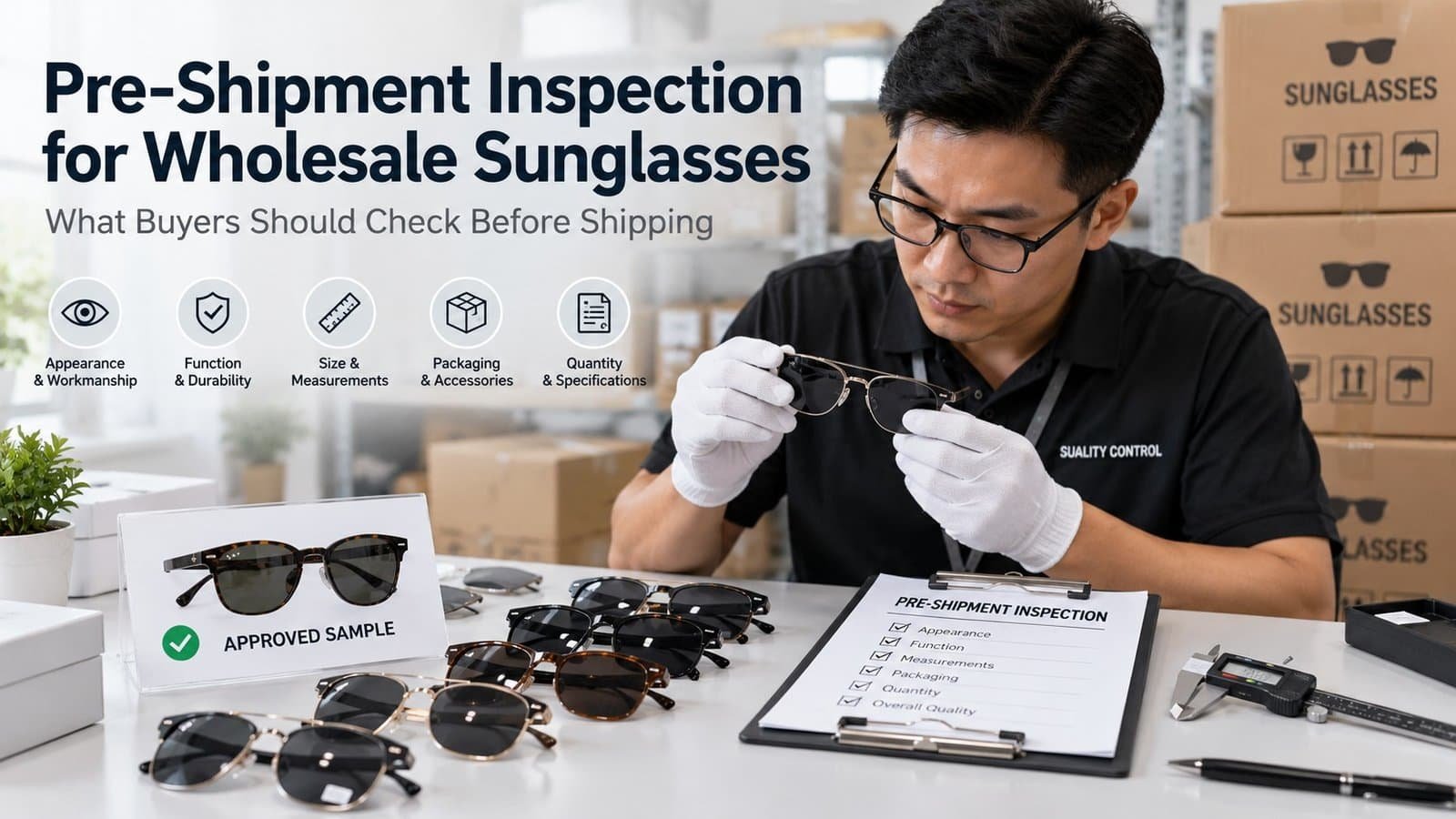
For larger orders, you may choose your own pre-shipment inspection standard or appoint an independent inspection company.
The commercial objective is simple: discover inconsistent production before the goods are shipped, not after customers start returning them.
Search: “Fast Sunglasses Supplier” → Ask for the Complete Production Timeline
A supplier saying “30-day production” does not necessarily mean your order ships in 30 days.
The clock may only start after the final sample is approved and all materials are ready.
A realistic schedule can include:
Specification confirmation → artwork → sample → sample revision → tooling if needed → pre-production approval → raw-material preparation → mass production → QC → packaging → shipment.
Change one component halfway through the process and the schedule may change with it.
This happens frequently when a buyer approves the frame but later changes the lens tint, logo process, packaging or Pantone color.
Instead of asking:
“How fast can you make it?”
Ask:
“If I approve the sample on October 10, please show me the expected dates for material preparation, production completion, inspection and shipment.”
Dates expose dependencies.
Words such as “fast” do not.
Search: “Reliable Sunglasses Supplier” → Ask for Evidence, Not Adjectives
Reliability is demonstrated through consistency.
Before placing a substantial order, look for evidence connected to your actual project.
That may include relevant product test documents, an approved sample, production photos or video, company registration information, inspection procedures, technical drawings, traceable specifications, packaging confirmation and a written production schedule.
Do not ask whether the supplier has “certificates.”
Ask which document applies to your model, your material, your lens and your market.
Evidence tied to the order is much more useful than a folder containing unrelated reports.
A Better First Message to Send a Sunglasses Supplier in China
Compare these two inquiries.
“Hi, send me your sunglasses catalog and best price.”
The supplier has almost nothing to work with.
A stronger inquiry looks like this:
Hello, we are a sunglasses retailer/brand selling in Germany.
We are looking for approximately 1,000 pcs of rectangular sunglasses for our next collection. We prefer an acetate or premium plastic frame with TAC polarized lenses.
Customization required:
Frame color: black + tortoise
Lens: CAT 3 grey polarized
Logo: outside temple
Packaging: branded pouch + box
Target market: EU
Please advise:
Recommended frame/material option
MOQ per color
Sample cost and sample lead time
Unit price and what the quotation includes
Available test/compliance documents for the proposed specification
Mass-production lead time after sample approval
Please also recommend similar existing models if they can reduce development time or MOQ.
This message immediately tells the supplier whether it should recommend a stock model, ODM modification or full OEM project.
That usually leads to a faster and more accurate quotation.

Common Mistakes When Sourcing Sunglasses from China
Asking for Price Before Confirming the Specification
Changing from standard PC lenses to TAC polarized lenses after receiving a quotation changes the product.
Confirm the core specification first, then compare price.
Comparing Different Materials as If They Were the Same Product
A PC injection frame, TR90 frame, handmade acetate frame and metal frame can have completely different manufacturing processes and cost structures.
A photo alone is not enough for comparison.
Asking Only for “Low MOQ”
MOQ depends heavily on customization.
Separate the MOQ for the frame, color, lens, logo and packaging instead of requesting one vague number.
Asking for “CE/FDA” Before Defining the Product and Market
Compliance follows the intended product and destination market.
Tell the supplier where the sunglasses will be sold and how they will be marketed before requesting documentation.
Changing Specifications After the Production Plan Is Confirmed
A late change that appears minor to a buyer can restart procurement.
Changing a custom frame color, lens coating or packaging component may require a new material order or sample.
Freeze important parameters before mass production begins.
Buyer FAQ
1. Can I Source Sunglasses from China with a Small First Order?
Yes, especially when you use an existing frame and limit customization to branding, lens options or packaging. Full custom colors, special components and new molds normally create higher material or production minimums.
Ask for the MOQ by customization level, not simply the factory’s lowest advertised MOQ.
2. Should I Choose the Cheapest Sunglasses Supplier?
Not before making the specifications equal.
Compare the same frame material, lens, logo, packaging, quality requirements, testing requirements and Incoterm. A lower quotation for a different product is not a saving.
3. What Information Should I Send to Get an Accurate Sunglasses Quote?
At minimum, send the style or reference image, frame material if known, lens requirement, quantity, color quantity, logo requirement, packaging, destination market and required delivery date.
If you do not know the material yet, tell the supplier your target retail positioning and budget so suitable constructions can be proposed.
4. Conclusion: Search Less Like a Shopper. Ask More Like a Buyer.
Sourcing sunglasses from China is not mainly about finding the supplier with the lowest advertised MOQ, cheapest price or longest list of certifications.
It is about turning your product idea into a specification that can be priced, sampled, tested and reproduced consistently.
Instead of searching:
Cheap sunglasses. Low MOQ. CE supplier. Fast factory. High quality.
Ask:
What material am I buying? What lens specification? What level of customization? What does the price include? Which documents apply to this product? What exactly am I approving at sample stage? How will the factory reproduce it during bulk production?
Those questions make supplier comparisons much clearer—and reduce costly surprises after the deposit is paid.
Planning Your Next Sunglasses Order?
Send us your reference image or design, estimated quantity, target market, lens requirement and customization needs.
We can help you compare three practical sourcing routes:
1. Existing model + private label — lower development risk and faster market testing.
2. Existing model + ODM customization — more brand differentiation without developing everything from zero.
3. Full OEM development — suitable when the frame structure itself needs to be unique.
Instead of asking for one vague “best price,” ask us to show you the options.
That makes it easier to choose the right balance of MOQ, unit cost, customization and launch time before you commit to production.