Buying wholesale reading glasses involves more than finding an attractive frame at a competitive price. Retailers and distributors need to choose the right lens powers, frame styles, materials, and quantities for their customers.
A successful reading glasses collection starts with four decisions: who will buy the glasses, which reading powers to stock, how many frame styles to offer, and how to manage inventory across different SKUs.
Before ordering in bulk, buyers should also verify optical quality, product labeling, applicable regulations, and customization requirements.
This guide explains how to build a practical wholesale reading glasses assortment for pharmacies, supermarkets, optical retailers, and private-label eyewear brands.
Start with Your Retail Market, Not the Reading Glasses Design
The right reading glasses assortment depends on where the products will be sold.
A pharmacy chain may need clearly labeled reading powers and simple product displays. An optical boutique may prioritize frame design and finishing, while an online retailer must consider product photography, sizing information, and returns.
Match Reading Glasses to Different Sales Channels
| Sales Channel | Main Purchasing Priorities | Suggested Product Approach |
|---|---|---|
| Pharmacies | Clear power identification, reliable quality, easy replenishment | Classic styles with organized power assortments |
| Supermarkets | Competitive pricing, simple displays, recognizable designs | Limited styles with popular neutral colors |
| Optical Stores | Frame appearance, fit, materials, product differentiation | Wider style and material selection |
| Online Retailers | Clear specifications, consistent quality, attractive presentation | Distinctive styles with detailed product information |
| Wholesale Distributors | Flexible assortments, stable supply, efficient inventory management | Repeatable designs with adjustable power mixes |
These are starting points rather than fixed rules. A premium pharmacy chain may require more sophisticated designs than a budget optical retailer.
Define Your Target Customers and Price Positioning
Before selecting products, clarify the intended retail price range and customer expectations.
An entry-level collection may prioritize practical PC frames, standard colors, and simple packaging.
A mid-range collection could introduce spring hinges, more refined finishes, and additional shapes.
A premium range may use carefully finished acetate or metal frames, more detailed hardware, and branded packaging.
The important question is not simply which frame looks better.
It is whether the additional features support your target selling price and purchasing budget.

Understand Reading Glasses Powers Before Placing a Wholesale Order
Unlike ordinary fashion eyewear, ready-made reading glasses contain lenses with a specified positive optical power.
Ordering the wrong combination of reading powers can create two problems: unsold inventory in some strengths and frequent stockouts in others.
What Do +1.00, +1.50, +2.00 and +3.00 Mean?
Reading glasses powers are normally expressed in diopters (D).
For example:
+1.00D: A lower positive lens power.
+1.50D: A higher positive power than +1.00D.
+2.00D: A stronger positive power than +1.50D.
+2.50D and +3.00D: Higher positive powers within many ready-made reading glasses assortments.
The larger the positive number, the stronger the lens power.
However, the correct power for an individual depends on their visual requirements and eye health. Age alone is not a reliable way to determine the appropriate strength.
Ready-made readers typically have matching powers in both lenses. They do not replace individualized prescription spectacles for people who need different powers in each eye, astigmatism correction, or other personalized optical adjustments.
Which Reading Powers Should Retailers Stock?
There is no universal reading power distribution that works for every market.
An established pharmacy buyer should start with historical sales data. A new distributor may need to test several powers before identifying local purchasing patterns.
Before ordering, consider:
Previous sales by reading power.
The target market and customer profile.
Available retail display space.
Supplier minimum order quantities.
The frequency of planned replenishment.
When reliable data is unavailable, a mixed-power trial order may be more useful than purchasing the same quantity of every strength.
How to Plan a Mixed-Power Wholesale Order
Suppose a retailer wants to test 400 pairs of reading glasses across five powers.
The following allocation is an illustrative starting model, not verified market sales data.
| Reading Power | Example Allocation | Quantity |
|---|---|---|
| +1.00D | 15% | 60 pairs |
| +1.50D | 20% | 80 pairs |
| +2.00D | 30% | 120 pairs |
| +2.50D | 20% | 80 pairs |
| +3.00D | 15% | 60 pairs |
| Total | 100% | 400 pairs |
The purpose of this model is to show how quantities can be distributed, not to suggest that +2.00D is always the strongest seller.
The buyer should adjust the allocation based on actual sales results.
It is also important to confirm whether the supplier allows different reading powers to be combined within the same order and whether minimum quantities apply per model, color, or power.
For projects requiring multiple strengths, explore our custom reading glasses and discuss the available reading power assortment before placing your order.

Choose Reading Glasses Frame Styles for Your Customers
Reading glasses should be comfortable, easy to identify, and appropriate for the intended retail audience.
Instead of introducing too many designs immediately, start with a manageable selection of frame shapes.
Full-Size vs Half-Eye Reading Glasses
Full-size reading glasses cover the normal viewing area and are a familiar choice for everyday near-vision tasks.
Half-eye reading glasses generally have a shallower frame shape and are designed to sit lower on the nose, allowing users to look over the lenses when viewing distant objects.
These two constructions serve different wearing preferences.
A half-eye design should not be confused with a semi-rimless frame, which describes how the lenses are mounted rather than where the glasses sit on the face.
Buyers should review actual frame dimensions and wearing characteristics before deciding which designs suit their market.
Rectangle, Round and Cat-Eye Designs
Different frame shapes can help create a balanced collection.
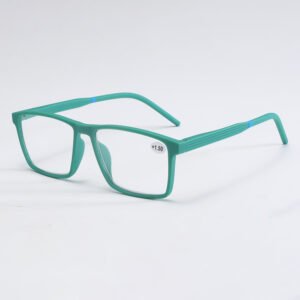
Rectangle reading glasses offer a clean, familiar appearance suitable for a wide range of retail environments. They can be a practical starting point for a collection built around simple everyday styling.
Round reading glasses create a softer, vintage-inspired appearance. They may suit optical boutiques or brands developing a more distinctive visual identity.
Cat-eye reading glasses provide a more expressive fashion direction and can add variety to collections targeting style-conscious shoppers.
For a conventional retail assortment, a neutral rectangular model and one more distinctive design may offer enough variety for an initial trial.
Buyers looking for a classic starting point can review our rectangle reading glasses.
Check Frame Size, Fit and Wearing Comfort
Frame appearance is only one part of product selection.
Before approving a reading glasses model, request the following specifications:
| Measurement | Why It Matters |
|---|---|
| Lens Width | Influences lens size and the available viewing area |
| Bridge Width | Affects how the frame sits on the nose |
| Temple Length | Influences how the glasses fit around the ears |
| Overall Frame Width | Helps determine whether the frame is suitable for the intended fit range |
| Lens Height | Affects the shape and usable lens area |
Also inspect the finished weight, nose-contact surfaces, temple pressure, hinge movement, and how securely the lenses are retained.
The size printed inside the temple is useful, but it does not fully describe overall frame fit.
Compare Frame and Lens Materials Before Buying in Bulk
Frame and lens materials influence appearance, product cost, comfort, manufacturing requirements, and retail positioning.
There is no single material that is best for every wholesale reading glasses collection.
PC, TR90, Acetate and Metal Reading Glasses Frames
PC Frames
Polycarbonate frames are commonly used for economical reading glasses. They can provide lightweight construction and are suitable for many mass-market designs.
However, flexibility and adjustment possibilities depend on the frame construction rather than the material name alone.
TR90 Frames
TR90 is frequently selected for lightweight eyewear designs where flexibility is desirable.
Buyers should confirm how the specific frame maintains its shape and whether the bridge or temples can be adjusted.
Acetate Frames
Acetate is suitable for collections emphasizing rich colors, layered patterns, and polished surfaces.
It can help differentiate a premium reading glasses collection, although the final quality depends on material selection, machining, polishing, and assembly.
Metal Frames
Metal frames are appropriate for slim profiles and classic optical styling.
Buyers should examine plating or coating consistency, nose pad construction, hinge quality, and the suitability of metal components for the target market.
AC, PC and Other Reading Lens Options
Reading lens materials also need careful comparison.
AC (Acrylic) Lenses
Acrylic lenses are used in many economical reading glasses programs. They can provide an affordable solution for standard positive-power lenses when manufactured to the required optical specifications.
PC (Polycarbonate) Lenses
Polycarbonate lenses offer relatively low weight and good impact resistance compared with many conventional lens materials.
However, impact resistance does not automatically guarantee superior optical performance.
Other Lens Materials
Depending on product design and manufacturing capabilities, alternative lens materials may also be considered.
For all lens types, buyers should confirm optical power accuracy, surface quality, applicable tolerances, coating performance, and the required test methods.
Do not assume that one lens material is automatically clearer or better simply because it costs more.

Build a Reading Glasses Assortment Without Creating Too Many SKUs
A major challenge in wholesale reading glasses is that one frame design can quickly turn into dozens of separate inventory items.
Each combination of frame style, color, and reading power may require its own SKU.
Start with a Limited Number of Frame Styles
Consider a retailer starting with:
2 frame designs
2 colors per design
5 reading powers
The total SKU count would be:
2 Styles × 2 Colors × 5 Powers = 20 SKUs
Even with only two frame designs, the buyer must manage 20 separate stock combinations.
If the collection expands to five styles, three colors, and six powers, the total increases to 90 SKUs.
That creates more purchasing decisions, labeling work, inventory records, and potential stock imbalances.
For a new collection, starting smaller usually makes product performance easier to evaluate.
Balance Frame Colors and Reading Powers
A practical approach is to begin with core colors such as black, tortoiseshell, or transparent neutral tones, then introduce additional colors selectively.
The goal is not to choose the most conservative colors for every brand.
It is to avoid multiplying untested combinations before understanding customer preferences.
For example, a retailer could launch one rectangular design in two colors while testing a second, more fashionable frame in only one color.
The number of combinations should reflect the available budget and the supplier’s actual minimum order requirements.
Use Sales Data to Decide Which Powers to Reorder
Once the collection reaches retail shelves, track sales at the SKU level.
A useful replenishment report should include:
| Data to Track | Purchasing Decision |
|---|---|
| Units Sold by Power | Which strengths require more inventory |
| Sales by Frame Design | Which shapes deserve repeat orders |
| Sales by Color | Which colors can be expanded or discontinued |
| Remaining Inventory | Which SKUs may be overstocked |
| Stockout Frequency | Which products need earlier replenishment |
| Customer Returns | Which products require quality or fit investigation |
Suppose one particular reading power sells quickly in a black rectangular frame but slowly in a transparent round frame.
The next order should not automatically increase that power across every design.
Instead, replenishment should reflect demand for the specific combinations that customers are purchasing.
This approach helps wholesale buyers use their inventory budget more effectively.
Check Reading Glasses Quality Before Bulk Production
Reading glasses quality control requires more than checking whether the frames look attractive.
Because the lenses provide optical magnification, the finished product must be inspected for functional accuracy as well as physical appearance.
Verify Lens Power and Optical Quality
Ask the supplier how the finished lenses are checked.
Important inspection points include:
Actual lens power compared with the marked value.
Power consistency between the right and left lenses.
Optical center positioning and unwanted prism.
Visible distortions, scratches, bubbles, and surface defects.
Correct lens mounting and retention.
A lensometer or other appropriate optical measuring instrument can be used to verify relevant lens characteristics against the agreed specification and applicable standard.
Measurements should be evaluated against the specified tolerances rather than expecting every measured value to be mathematically exact.
Inspect Frame Construction and Assembly
Reading glasses should also be checked for:
Frame alignment and balance.
Hinge movement and screw security.
Uneven temple angles.
Sharp edges or uncomfortable contact points.
Lens movement within the frame.
Surface finishing and color consistency.
Ask for representative samples from different production batches when consistency across a large order is important.
Check Power Labels, Packaging and Carton Accuracy
Mixed-power orders require additional attention during packing.
For example, a carton labeled +2.00D should contain the correct product model, color, and lens power.
Clear power labels, SKU identification, barcode information, and carton markings help prevent warehouse picking errors.
Before shipment, confirm the approved assortment against the packing list and inspection records.
For a broader sampling and approval process, see our eyewear sample policy.
What Should Buyers Confirm Before Requesting a Wholesale Reading Glasses Quote?
A useful wholesale quotation should specify more than the total quantity.
Before contacting a supplier, prepare the following information:
| Purchasing Detail | Information to Provide |
|---|---|
| Destination Market | Country or region where the glasses will be sold |
| Retail Channel | Pharmacy, supermarket, optical shop, online store, or distributor |
| Frame Styles | Preferred shapes, models, and dimensions |
| Frame and Lens Materials | Required or preferred materials |
| Reading Powers | Complete list of required diopter strengths |
| Quantity Allocation | Estimated quantity for each model, color, and power |
| Customization | Logo, frame colors, power labels, barcodes, and packaging |
| Compliance | Applicable standards and required documentation |
| Delivery | Required shipment date and destination |
Ask the supplier to explain how minimum order quantities apply.
For example, does the MOQ refer to the total order, one frame design, one color, or an individual reading-power SKU?
Also ask which changes are possible using existing products and which require additional sampling or production work.
Clear specifications help suppliers prepare quotations that can be compared on the same basis.
FAQ About Wholesale Reading Glasses
1. What reading glasses powers should retailers stock?
Retailers should base their assortment on local sales data, customer demand, and the intended retail channel. Common wholesale programs offer several positive lens powers, but there is no universal best-selling power distribution. New retailers can use a controlled mixed-power trial to evaluate demand before placing larger orders.
2. Can I order different reading powers in one wholesale order?
Yes, many suppliers offer mixed-power orders. However, available strengths and minimum quantities can vary by model, lens material, and customization requirements. Buyers should confirm the minimum order quantity for each power and whether powers can be combined within the same frame design.
3. What is the difference between ready-made reading glasses and prescription glasses?
Ready-made reading glasses generally use matching positive-power lenses and are not individually prescribed for one person’s complete optical needs. Prescription glasses are made according to an individual’s specific prescription and may include different powers for each eye, astigmatism correction, and other optical adjustments. Ready-made reading glasses are not a substitute for professional eye care.
4. Can wholesale reading glasses be customized with my logo?
Yes. Depending on the frame material and manufacturing process, suppliers may offer temple logos, custom frame colors, branded packaging, and SKU labels. Some projects may also support a customized assortment of reading powers. Buyers should confirm the available options, minimum quantities, and sample approval requirements before ordering.
5. What should I check before importing reading glasses?
Verify the intended market’s regulatory requirements, applicable product standards, optical power accuracy, frame quality, labeling, and traceability information. Also confirm that the approved product samples match the specifications used for bulk production and that the final shipment contains the correct quantities for each SKU.
Conclusion: Build a Reading Glasses Collection Around Real Retail Demand
A successful wholesale reading glasses collection does not need dozens of frame styles or an unnecessarily complicated power assortment.
It needs products that match the target customers, clearly defined lens powers, dependable quality, and an inventory plan that can be adjusted as sales develop.
Start by identifying your retail market. Select a manageable number of frame designs, plan the reading power distribution, and confirm materials, quality requirements, and labeling before ordering.
After the first sales cycle, use actual SKU performance to decide which styles and powers deserve more inventory.
At Luba Eyewear, we support wholesale buyers developing reading glasses collections for different retail channels, including private-label customization and mixed-power purchasing discussions.
Planning Your Next Wholesale Reading Glasses Order?
Explore our wholesale reading glasses collection or contact our team with your target market, preferred frame styles, required reading powers, and estimated quantities.
We can help you review available models, customization options, and quotation requirements before you commit to bulk production.