Are you tired of missing peak seasonal sales because your factory took four months to develop a custom mold? Or perhaps you recently launched a “new” eyewear collection, only to find three competing brands selling the exact same frame geometry on Amazon?
Choosing between OEM vs ODM eyewear manufacturing isn’t just a routine supply chain decision. It is the core business strategy that dictates your cash flow, your time-to-market, and ultimately, your brand’s competitive moat.
Whether you are an established European optical retailer looking to expand your private label, or a fast-growing US sunglasses brand scaling up, picking the wrong manufacturing route can tie up thousands of dollars in dead inventory. In this comprehensive guide, we strip away the industry jargon. We will analyze the real-world costs, production timelines, and strategic advantages of both OEM (Original Equipment Manufacturer) and ODM (Original Design Manufacturer) models, helping you make the most profitable decision for your next quarterly purchase order.
Lorem ipsum dolor sit amet, consectetur adipiscing elit. Ut elit tellus, luctus nec ullamcorper mattis, pulvinar dapibus leo.
Understanding the Buyer’s Dilemma
Before diving into the technicalities, let’s address the elephant in the room: Risk vs. Control.
B2B eyewear buyers constantly walk a tightrope. On one hand, you want total control over the design, ensuring your frames are 100% unique to justify a high retail markup. On the other hand, custom designs require capital for molds, rigorous prototyping, and long lead times. If the trend shifts before your custom frames hit the warehouse, your capital is trapped.
This is where understanding the distinct boundaries between OEM and ODM becomes your most powerful purchasing tool.
What is OEM Eyewear? (Original Equipment Manufacturer)
In the eyewear industry, OEM means you (the brand) bring the design, and the factory brings the manufacturing muscle. You own the intellectual property. You provide the technical drawings (CAD files), specify the exact materials, and dictate the hinge mechanics. We, as the manufacturer, execute your vision.
The OEM Process: From Concept to Physical Frame
Technical Evaluation: You submit 2D/3D drawings. Our engineers assess feasibility, shrinkage rates of materials, and structural integrity.
Mold Creation & Tooling: Depending on the material, custom molds are cut.
Prototyping: A physical sample is produced for your approval.
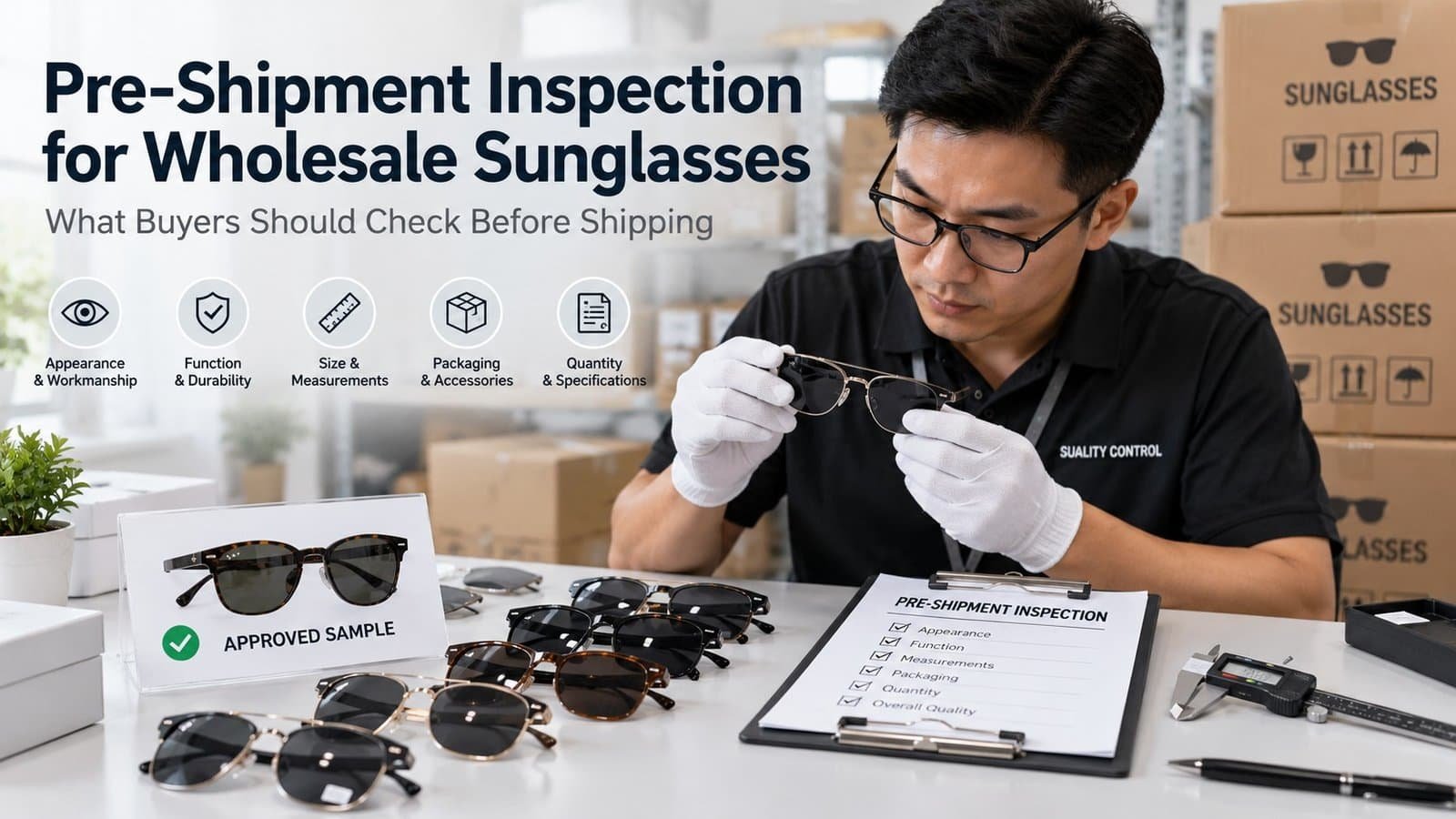
Mass Production & QC: Once approved, bulk manufacturing begins, followed by rigorous quality control.
Scenario-Based Pain Point: The Aftermarket Nightmare
Have you ever received a frantic email from a key wholesale distributor complaining that the spring hinges on your latest batch are snapping after just one month of daily wear? Generic factories often cut corners on internal mechanics.
The OEM Solution: OEM gives you the absolute power to dictate component quality. You can explicitly specify the integration of 5-barrel hinges and anti-scratch lens coatings. By controlling the bill of materials, you eliminate aftermarket returns and protect your brand’s reputation.
Pros and Cons of OEM Eyewear
Pros:
- Absolute Exclusivity: Nobody else in the market has your exact frame. Make your products highly competitive in the market. This is your brand moat.
Uncapped Profit Margins: Unique designs command premium retail prices.
Micro-Control: You dictate every millimeter, from the nose pad angle to the temple core wire design.
Cons:
High Upfront Capital: Mold fees for TR90 or PC injection can range from $1,000 to $3,000+ per model.
Longer Time-to-Market: Prototyping and tooling can take 45-60 days before mass production even begins.
Higher Minimum Order Quantities (MOQ): Factories typically require 1,000+ pieces per model to justify the machine setup time.
What is ODM Eyewear? (Original Design Manufacturer)
ODM is the fast track to market. Also known as “Private Labeling,” ODM means the factory has already invested the time and money into designing the frame, opening the mold, and testing the ergonomics. You browse a catalog of proven, trend-ready designs, select the ones that fit your brand DNA, and we customize them with your logo, brand colors, and custom packaging.
The ODM Process: Speed and Agility
Catalog Selection: You choose from hundreds of pre-tooled designs.
Customization: You select frame colors, lens types (e.g., polarized, UV400, blue-light blocking), and logo placement (laser engraved, silk printed, or metal inlay).
Rapid Production: Since molds already exist, we move straight to material sourcing and production.
Scenario-Based Pain Point: Missing the Summer Rush
Picture this: It’s late April. You realize oversized, translucent acetate frames are trending heavily on TikTok and Instagram. If you start an OEM project now, the frames will arrive in late August—completely missing the summer peak season.
The ODM Solution: Let your competitors wait. By utilizing an ODM strategy with Yiwu Luba Eyewear Co., Ltd., you can select an existing oversized acetate model from our premium catalog. We laser-engrave your logo on the temples and ship within 15-25 days. You hit the market in May, capturing the trend at its absolute peak and locking in higher revenue.
Pros and Cons of ODM Eyewear
Pros:
- Zero Tooling Costs: No mold fees. Your capital goes directly into inventory and marketing.
- Lightning Fast Speed: Go from order to shipping in 15-30 days.
- Lower Risk & MOQ: Test new markets with as few as 300 pieces per style.
Cons:
- Lack of Exclusivity: Other brands might purchase the same base frame (though different colors and logos help differentiate).
- Design Limitations: You cannot alter the core physical geometry of the frame.
OEM vs ODM Eyewear: A Direct B2B Cost & Time Comparison
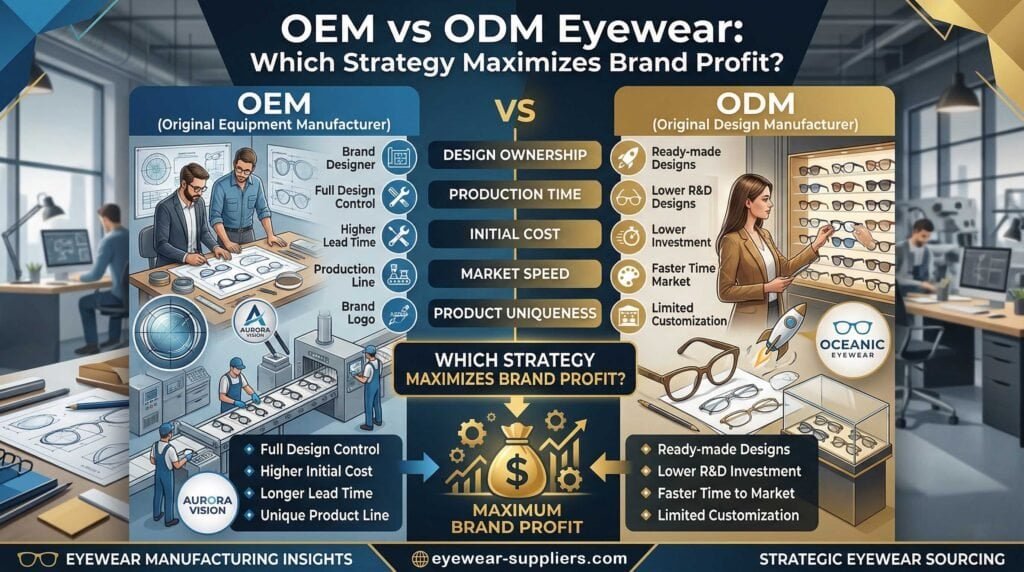
To help you make a data-driven decision, let’s look at the hard metrics.
| Feature | OEM (Custom Design) | ODM (Private Label) |
| Intellectual Property | Brand owns the design | Factory owns the design |
| Mold / Tooling Costs | High ($1,000 – $3,000+) | Zero ($0) |
| Average MOQ | 1,000 – 1,200 pcs / model | 300 – 600 pcs / model |
| Time-to-Market | 60 – 120 days | 15 – 45 days |
| Customization Level | 100% (Shape, Material, Core) | Moderate (Color, Lens, Logo) |
| Ideal For | Established brands, high-margin luxury | Startups, trend-testing, fast fashion |
Deep Dive: Material Science & E-E-A-T in Manufacturing
Whether you choose OEM or ODM, the underlying materials define your product’s market positioning. Many buyers are misled by factories that promise “high quality” without explaining why. As your manufacturing partner, we believe in transparency.
The Acetate Difference: Italian Mazzucchelli vs. Standard Injection
When targeting high-end markets in the UK, Germany, or the US, plastic injection simply won’t cut it.
We utilize genuine Mazzucchelli Acetate for our premium lines. Unlike petroleum-based plastics, premium cellulose acetate is derived from natural cotton and wood pulp.
The Manufacturing Reality: Cheap factories tumble-polish acetate frames for 3 days, resulting in a superficial shine that dulls quickly. At Yiwu Luba Eyewear, our premium acetate undergoes up to a 7-day multi-stage tumbling process using specialized wood chips and polishing pastes.
The Benefit to You: This rigorous process yields a deep, warm luster and a material that is hypoallergenic and easily adjustable by opticians. It is the silent guarantor of your brand’s premium markup. You can confidently sell a $150 frame because the tactile quality justifies it.
TR90 & PC (Polycarbonate): The Performance Kings
For sports eyewear or lightweight daily wear targeting South America (Brazil, Venezuela) or Southeast Asia, TR90 is the undisputed champion. It is highly flexible, impact-resistant, and remarkably light.
The Engineering Insight: If a TR90 frame is injected at the wrong temperature or cooled too rapidly, it suffers from internal stress fractures, leading to breakage in cold weather. We employ precise thermal regulation in our injection molding, ensuring your TR90 frames retain their “memory flex” properties regardless of the climate your customers live in.
Strategic Commercial Application: How to Use Both
The most successful B2B buyers don’t restrict themselves to just one method. They use a hybrid approach to maximize cash flow and brand equity.
The “Anchor & Test” Strategy
Anchor with OEM: Invest your capital into 2 or 3 flagship OEM designs. These are your brand’s signature pieces. Because they are 100% unique, you can run extensive PR campaigns around their exclusive architecture.
Test and Expand with ODM: Use our ODM catalog to quickly fill out the rest of your SKU matrix. Want to test if your audience will buy aviators? Don’t open a $2,000 mold. Buy 300 pieces of our premium ODM metal aviators, brand them, and test the waters. If they sell out, you’ve generated risk-free profit.
Why Partner with Yiwu Luba Eyewear Co., Ltd.?
When you source through Eyewear-Suppliers.com, you aren’t just buying frames; you are buying 15 years of optimized supply chain efficiency.
- 3-Day Rapid Prototyping: For OEM projects, we’ve optimized our 3D printing pipelines to get physical prototypes into your hands weeks faster than the industry average. Let your independent brand beat the big competitors to market.
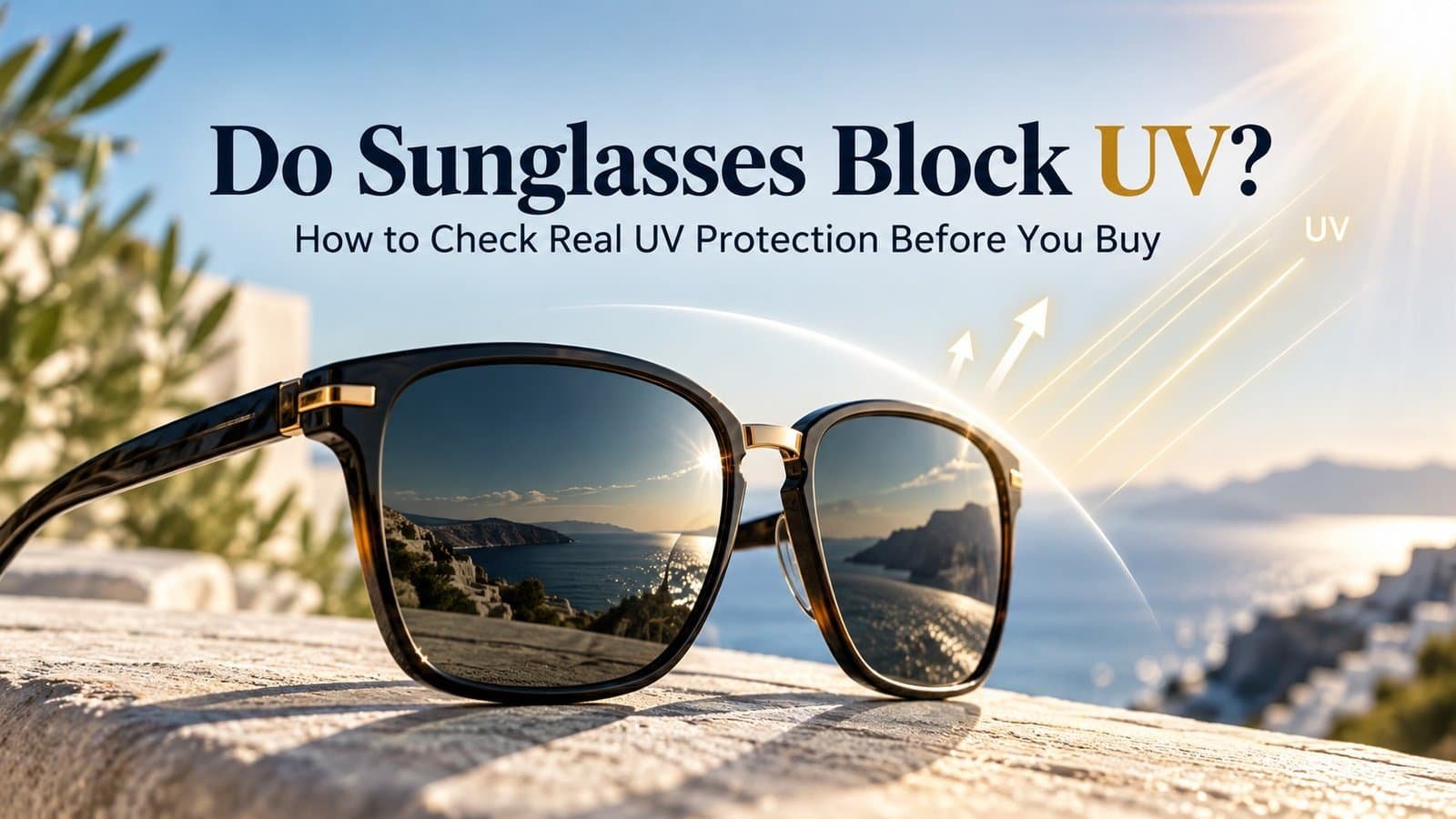
Strict CE & FDA Compliance: Selling in Europe or the US? Our factory maintains rigorous testing for drop-ball impact (FDA) and UV400 transmission standards. Your shipments will never be held up at customs due to non-compliance.
Flexible Scaling: We grow with you. We accommodate realistic MOQs for growing brands while possessing the heavy-duty infrastructure to produce hundreds of thousands of units for major wholesalers.
Stop Guessing, Start Scaling
The debate between OEM vs ODM eyewear ultimately boils down to your current business goals. If you have a proven market and need a unique brand moat, OEM is your investment in the future. If you need to capitalize on immediate trends with minimal capital risk, ODM is your cash-flow generator.
Take Action Today
Are you ready to optimize your eyewear sourcing? Stop browsing endless, unreliable directories and partner with a manufacturer that understands your profit margins.
Contact us now to receive your customized manufacturing strategy. Send us a message detailing your current business stage, and our B2B eyewear consultants will immediately provide you with:
A free ROI analysis comparing OEM vs ODM for your specific project.
Our latest 2026 ODM Trend Catalog.
3 Tiered Pricing Options based on different materials (Acetate, TR90, Metal) and MOQ levels.
👉 Contact Us Here or Message us directly on WhatsApp to lock in your production schedule and secure your competitive advantage today.