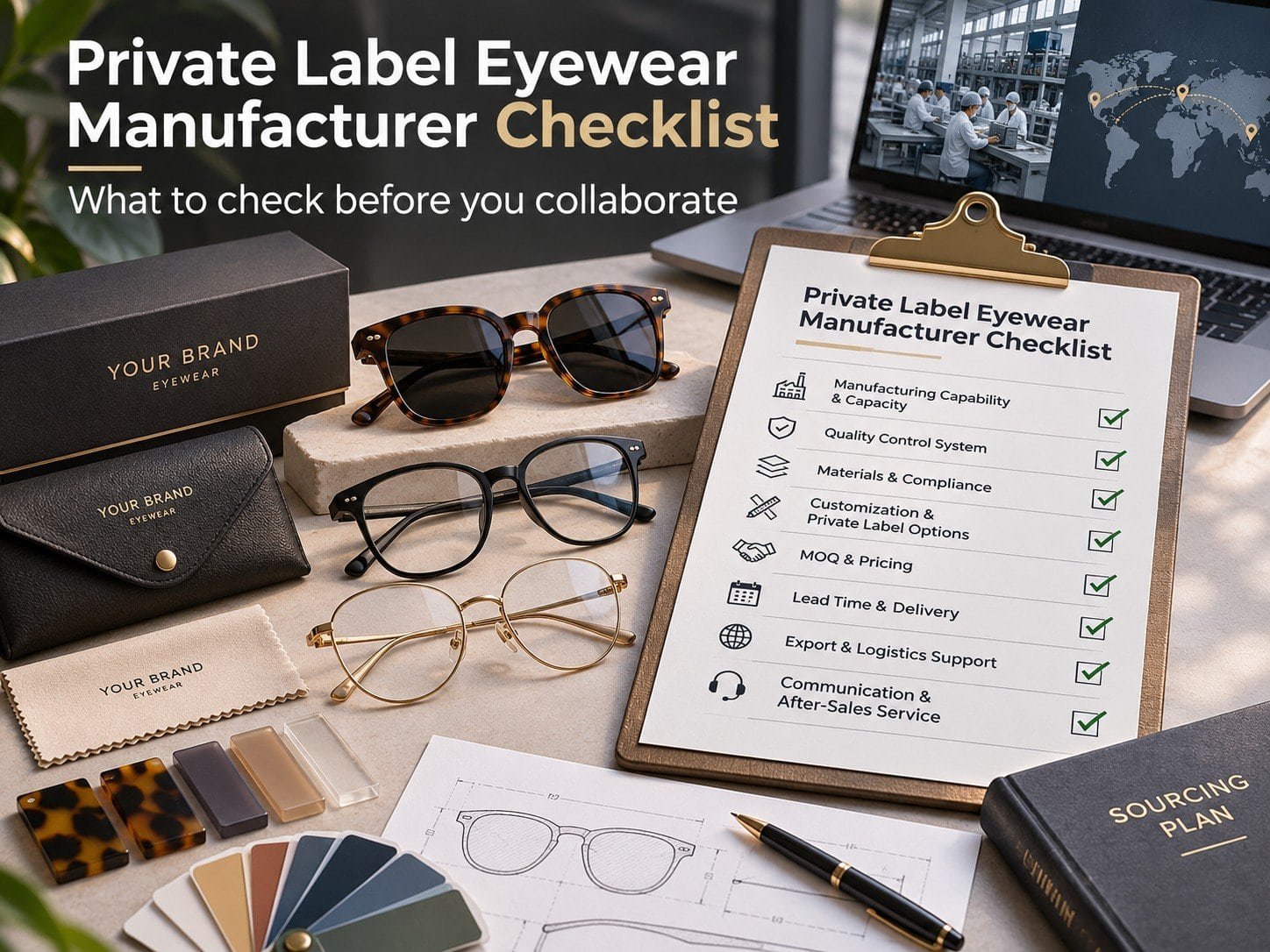
A private label eyewear manufacturer checklist should cover ten things before you commit: project fit, production capability, materials, customization, total costs, sample approval, quality control, compliance, delivery, and contract terms. A low quote tells you little about whether your first shipment will match the sample—or your next order will match the first.
This checklist is designed for brand owners, eyewear retailers, and wholesale buyers preparing to commit money to a supplier. Each section explains what to ask, what evidence to request, and which answers deserve a second look. Use it during a factory interview or while comparing quotations.
1. Does the Manufacturer Fit Your Private Label Eyewear Project?
Start with the product development route. Buyers sometimes request a fully custom quotation when they actually need an existing frame with their own logo. Others choose a catalog frame and only later discover they cannot change its bridge, hinge, or temple shape.
| Project route | What changes? | Best suited to |
|---|---|---|
| Private label / existing style | Logo, packaging, available frame and lens combinations | Testing demand with lower development risk |
| ODM modification | Selected colors, components, or design details, subject to tooling limits | Creating differentiation without starting from zero |
| Full OEM development | Original drawings, dimensions, tooling, component specifications | Brands needing a distinctive, repeatable product |
Ask: “Which parts of this frame can I change without opening a new mold?” Also establish whether you need exclusive design rights or simply exclusive use of a colorway. These are different commercial arrangements.
If your launch date is close, a proven frame with controlled customization may be sensible. If your brand depends on a particular fit or silhouette, investigate full OEM development before paying for samples. Our OEM/ODM eyewear manufacturing service explains the available development routes.

2. Can the Manufacturer Prove Real Production Capability?
A showroom, product catalog, and polished factory video are useful introductions. They do not establish who actually makes your glasses.
You may request an on-site demonstration of the production processes relevant to your order—such as material cutting and polishing, injection molding, metal frame assembly, lens fitting, or final inspection. Additionally, be sure to ask for the specific production address, sign a formal production contract, and verify documents such as the business license.
You might consider asking a practical question: “If 8% of our eyeglass frames fail the hinge inspection, what is the process for deciding whether to repair, replace, or scrap them?” A reliable partner should be able to explain their decision-making process and provide samples of past inspection records, rather than simply promising that “defects will never occur.”
For larger orders, it is advisable to request that the other party provide a factory audit report from a reputable third-party organization, as well as a quality management system certificate.
3. Are Frame Materials and Lens Specifications Clearly Defined?
“Premium acetate frame with UV400 lenses” is not a complete purchasing specification. It leaves too much open to interpretation.
For frames, confirm the exact material and grade: cellulose acetate, TR90, polycarbonate (PC), or a specified metal alloy. If Mazzucchelli acetate matters to your brand, ask for identifiable material records. For metal frames, clarify plating or coating requirements and corrosion-related checks. Colors should reference approved swatches or physical samples, not only photos.
Lenses require their own specification. Record material (for example PC, TAC polarized, nylon, or CR-39), tint, visible light transmission or filter category where relevant, UV protection claims, coating, and any agreed optical or performance tests. Polarization, lens darkness, and UV protection are not interchangeable properties.
Put fitting dimensions in millimeters—lens width, bridge width, temple length—and agree on production tolerances. “Same as sample” is helpful, but a drawing is much easier to inspect against.

4. Which Customization Options Are Actually Available?
Almost every private label eyewear supplier says it offers customization. The more revealing question is which changes can be made to this model, at this quantity, within this lead time.
Confirm logo technique and position, frame colors, lens materials and tints, hinge options, temple dimensions, accessories, retail boxes, hangtags, barcode labels, and instruction leaflets. Ask for a mockup showing the actual branding location. A laser mark on an acetate temple and a metal emblem inserted into a frame have different production requirements.
Be cautious when a supplier describes all changes as “easy.” A new lens tint may only need a new sourcing approval; altering a molded bridge can require tooling. Confirm whether a change affects fit, testing, sample costs, or the minimum order.
Buyer question: “Can you put my logo on the lens and match the frame color?”
Useful answer: “We need the exact model, logo artwork, target color reference, and quantity before confirming the method, sample plan, and cost.”

5. Are MOQ, Unit Prices, and Extra Costs Transparent?
A low unit price means little until you understand how the quote was built. Ask for pricing by model, color, and total order quantity. MOQ per style, MOQ per color, and minimum spend are not the same thing.
Please provide a detailed quotation that breaks down the costs for the eyewear, brand logo printing, custom packaging, molds, prototyping, testing, shipping, and any applicable taxes (or duties). Additionally, please specify the trade terms (such as EXW, FOB, CIF, or DDP) and the designated location. Different trade terms entail different allocations of costs, responsibilities, and obligations.
| Cost item | What to verify before paying |
|---|---|
| Unit price | Exact materials, lens specification, quantity tier, currency |
| Customization | Setup fees, per-logo charges, color minimums |
| Development | Mold ownership, sample revisions, tooling maintenance |
| Compliance and QC | Who pays for tests, re-tests, and third-party inspection |
| Delivery | Incoterm, destination, packaging volume, freight exclusions |
Compare landed cost per sellable pair, not just factory price per pair. For example, the cheapest quote may become more expensive if it excludes testing, packaging, or replacement of rejected stock. Higher prices do not automatically mean better quality.
Ask for two or three quantity-based quotations using identical specifications. Otherwise, you may be comparing different products without realizing it.

7. What Quality Control Happens Before Shipping?
“100% inspected” sounds reassuring. Ask what is inspected, against which standard, and how findings are recorded. Checking each pair for visible scratches is not the same as testing every performance characteristic of every lens.
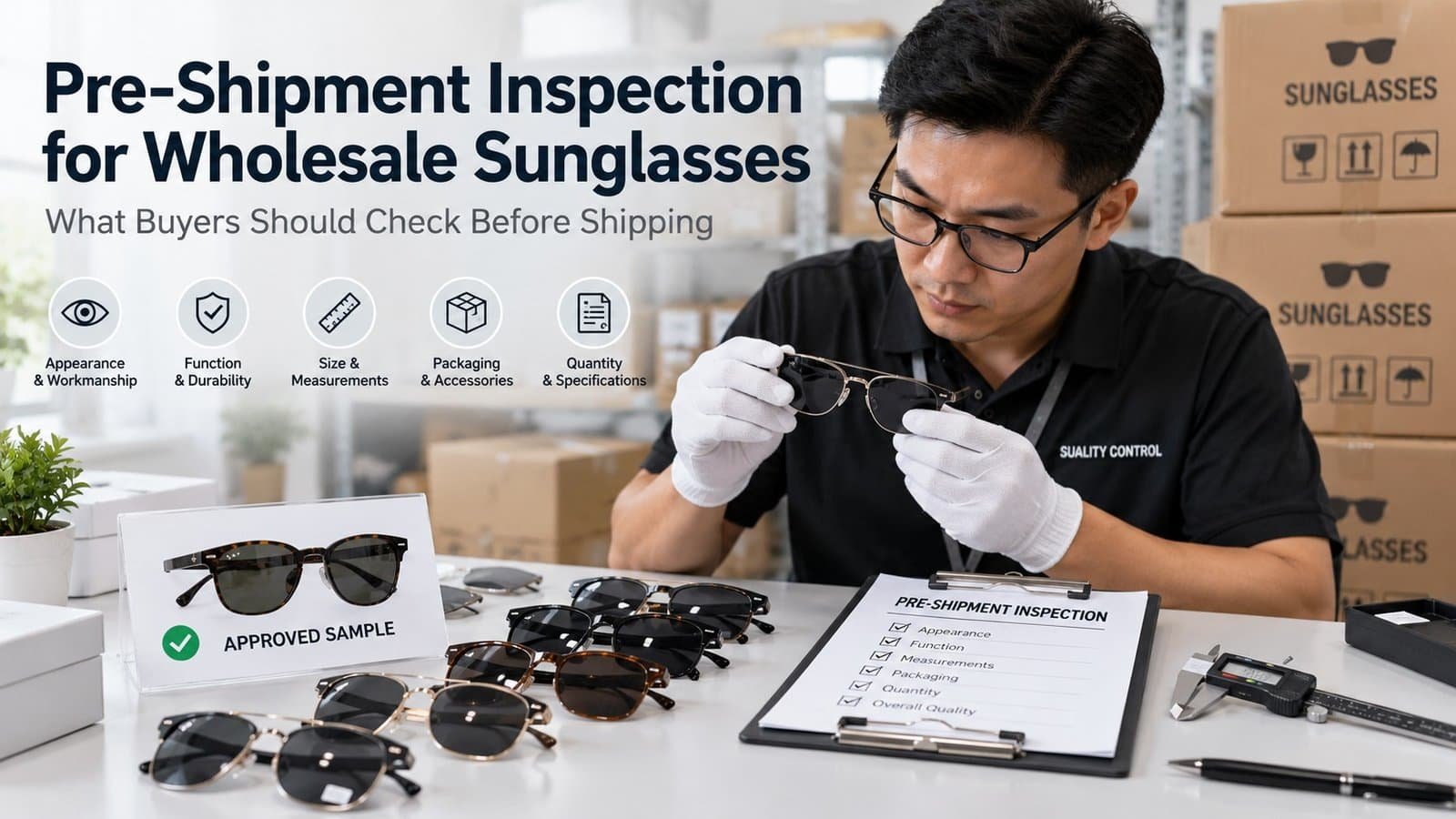
A workable eyewear manufacturing quality control plan has three stages: incoming material and component checks, in-process checks, and final inspection against the approved sample and purchase specification.
At final inspection, buyers should expect agreed checks of frame symmetry, hinges, temple movement, lens seating, surface defects, color consistency, logo position, dimensions, labeling, and packing quantities. Performance testing should follow the product type and agreed compliance plan.
Inspection sampling methods and acceptance criteria shall be established in writing. Furthermore, the procedures to be followed in the event of a non-conforming batch—such as sorting, reworking, re-inspection, replacement, or order cancellation—must also be clearly defined.
Most importantly, retain the right to review inspection results before the balance is released or shipment is authorized, subject to your agreed payment terms. A report issued after the container leaves the warehouse cannot prevent that shipment’s defects.
8. Can the Manufacturer Supply Compliance Documents for Your Market?
Do not accept “CE and FDA certified” as a substitute for product-specific records. Compliance depends on what the eyewear is intended to do and where it will be sold. Fashion sunglasses, prescription spectacle frames, and industrial safety glasses are not one regulatory category.
For example:
| Destination / product | Checks to raise with the supplier |
|---|---|
| United States — sunglasses and spectacle products | Applicable FDA establishment registration and device listing responsibilities, lens impact-resistance evidence under 21 CFR 801.410, labeling, and lot documentation |
| European Union — general-use sunglasses | Whether testing to EN ISO 12321-1 has been conducted; whether technical documentation and an EU Declaration of Conformity are available; whether the CE mark has been affixed; and whether the necessary user information has been provided.ion |
| Australia – Personal Protective Goggles | Has it been tested in accordance with the AS/NZS 1337.1 standard? Can you provide a test report issued by a reputable third-party organization, and is the necessary user information included? |
| Optical or occupational eyewear | Confirm the separate product-specific rules and tests rather than reusing a fashion-sunglasses report |
The U.S. FDA’s eyewear guidance covers device obligations and lens impact resistance. For U.S. projects, also check the FDA’s QMSR update: the revised quality system rule took effect on February 2, 2026. In the EU, Regulation (EU) 2016/425 sets out the PPE framework.
Ask for reports matching the actual model, lens, and materials you intend to purchase. Check the testing laboratory, date, scope, report number, and whether product changes require reassessment. Ask who prepares labels and carries importer or manufacturer responsibilities. Private labeling does not automatically transfer compliance risk to the overseas factory.
9. Can the Supplier Meet Delivery Dates and Reorders?
A delivery promise needs a starting point. Is the quoted lead time counted from deposit, artwork confirmation, final sample approval, or receipt of custom materials? Ask for dates for materials, production, inspection, packing, and handover to the freight provider.
Then discuss your second order. Which components will remain available? Can the supplier reserve a distinctive acetate color or lens tint? Will the same mold, dimensions, logo position, and material grade be used? A product that sells well but cannot be reproduced consistently is difficult to build a brand around.
Ask: “If we sell out faster than expected, what is the shortest realistic reorder schedule for the identical SKU?” Request a separate answer for standard materials and special-order components.
A useful supplier will identify the bottleneck rather than simply promise rush delivery. If your launch is seasonal, include a buffer for sample revisions, test results, customs clearance, and unexpected rework. Shipping and arrival dates are not interchangeable.
10. Are IP, Payment Terms, and After-Sales Responsibilities Clear?
Put the commercial safeguards in writing before transferring a deposit. For an original design, specify ownership of CAD files, molds, drawings, trademarks, and paid tooling. Also cover who may use the design, whether it can appear in the supplier’s catalog, and what happens to tooling if you change manufacturers.
An NDA or non-use agreement may help, but it is not a substitute for clear ownership clauses and enforceable remedies.
For payment, confirm deposit percentage, balance trigger, bank beneficiary, currency, refund conditions, and procedures for changes. Verify any bank-account change through an established contact channel.
For after-sales claims, define the defect reporting window, evidence required, responsibility for freight, and whether remedies mean credit, repair, or replacement. One particularly useful question is: “If customers report loose hinges three months after launch, what records will you review and how will we resolve the affected batch?”
The contract should connect complaints to batch identification and corrective action. That is what turns a one-time purchase into a supplier relationship you can manage.
Frequently Asked Questions About Private Label Eyewear Manufacturers
1) How do I verify whether an eyewear supplier is a real manufacturer?
You may request that the other party provide their production address, real-time video of their production processes, and recent production and quality inspection records. Trading companies can also be excellent partners, provided they are transparent about their role.
2) What is a reasonable MOQ for private label eyewear?
There is no universal minimum. Logo-only orders on existing stock can be much smaller than projects requiring custom colors, components, or new molds. Ask for MOQ per model and per color, then get written quantity tiers. Our private label eyewear guide covers the main launch approaches.
3) Should I approve a sample before paying the bulk deposit?
For an established style, at least approve representative product and branding samples before authorizing bulk production. For OEM development, agree on design and engineering milestones as well. Deposit arrangements vary, so tie each payment to a clear deliverable.
4) Is the cheapest OEM eyewear manufacturer usually the best option?
Not necessarily. Compare consistent specifications, landed costs, inspection rights, compliance evidence, and reorder stability. A slightly higher quote can be commercially preferable if it reduces the likelihood of rejects and missed launch dates.
Conclusion: Choose a Verifiable Manufacturer, Not Just a Low Price
The best private label eyewear manufacturer is one that can show you how your product will be made, tested, approved, shipped, and reproduced—not merely quote an attractive unit price.
Before committing, request three things: a specification-based quotation, a sample approval plan, and a list of compliance and QC documents for your destination market. Those will reveal more than another round of general factory promises.
At LUBA Eyewear, we support existing-style branding, ODM changes, and OEM development, from product specifications and sampling through packaging and delivery. Share your target market, frame references, expected quantity, and launch date. We’ll help identify a suitable development route and the questions that need resolving before production. Contact our eyewear manufacturing team to discuss your project and request a quotation.